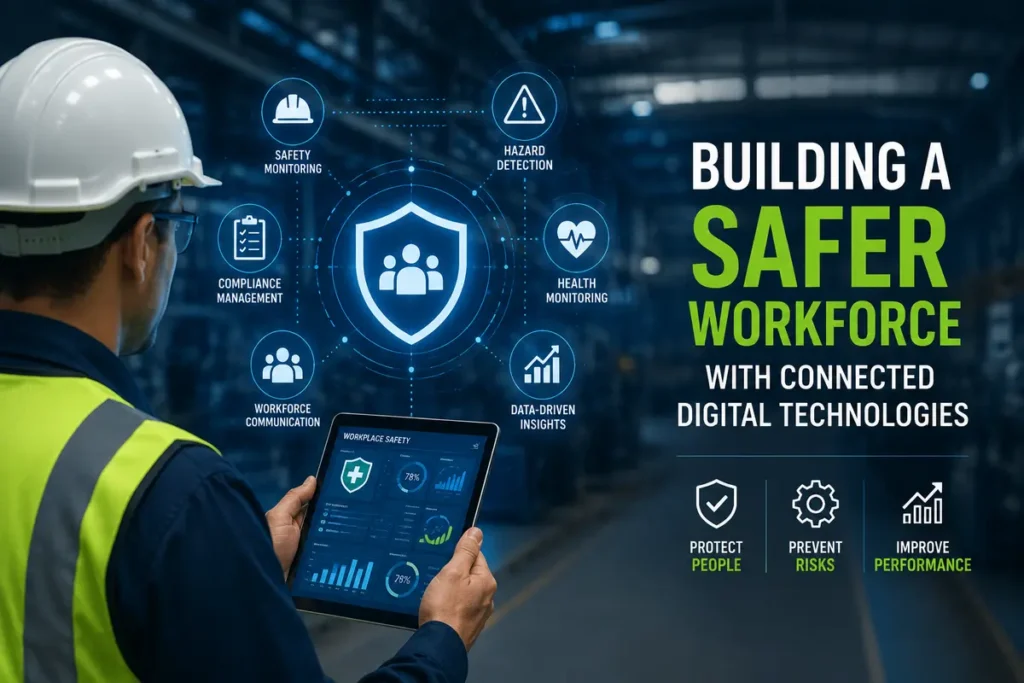
Modern workplaces are evolving rapidly, bringing new safety challenges alongside greater connectivity and efficiency. Traditional safety measures alone can no longer address today’s complex work environments. Businesses now need smarter, technology-driven approaches to protect employees, improve visibility, and respond faster to workplace risks through connected digital solutions.
The urgency of improving workplace safety is reflected in labor statistics. According to the BLS, the number of work-related fatalities in North Carolina increased by 10.7 percent in 2024. The fatal work injury rate also climbed to 4.1 fatalities per 100,000 full-time equivalent (FTE) workers in 2024. This was in comparison to the rate of 3.7 in 2023.
These figures highlight a troubling reality. Despite advancements in industrial operations and safety regulations, workplace hazards continue to threaten employees across industries.
Connected technologies are reshaping how organizations protect their employees. This article explores how connected digital technologies are revolutionizing workplace safety across industries.
Wearable Technology Is Redefining Workforce Safety
Wearable technology is transforming workplace safety by turning traditional protective equipment into intelligent, connected systems that can monitor workers, detect risks, and enable faster response in real time.
Industries such as construction, manufacturing, mining, logistics, and healthcare are increasingly adopting wearable devices to strengthen employee protection, reduce workplace incidents, and build a more proactive safety culture.
Smart Helmets and Body-Worn Cameras
Smart helmets equipped with sensors, GPS tracking, and cameras can detect impacts, monitor hazardous environments, and instantly trigger emergency alerts during accidents or unsafe situations. Their growing adoption reflects the rising demand for connected safety solutions across industrial environments.
The global smart helmet market size is estimated at USD 520.56 million in 2025. Precedence Research projects it to grow from USD 641.37 million in 2026 to nearly USD 3,756.73 million by 2035. This is at a CAGR of 21.85% during the forecast period.
Additionally, a body worn camera can be a savior. These devices are becoming a vital workplace safety tool, especially in retail and healthcare. Retail shrinkage exceeded $112 billion in 2023, while more than 67% of retailers reported a rise in aggressive behavior toward employees.
According to Vestige, Walmart piloted body cameras in Dallas-area stores. Meanwhile, Missouri-based CoxHealth adopted them for hospital security following a rise in patient-related incidents.
Reducing Fatigue and Preventing Human Error
Fatigue and human error continue to be among the leading causes of workplace accidents, particularly in physically demanding and high-risk industries. Wearable technology plays a critical role in minimizing these risks by monitoring worker health and detecting early signs of exhaustion before performance is affected.
Advanced wearable systems analyze biometric indicators such as heart rate variability, body temperature, and muscle activity to assess worker fatigue in real time. Increasingly, organizations are combining these devices with artificial intelligence to improve the accuracy and speed of fatigue detection.
Research published in ScienceDirect highlights that integrating wearable technologies with AI creates a highly effective approach for monitoring both physical and cognitive fatigue. By combining multiple physiological signals and motion data with machine learning and deep learning models, these intelligent systems can identify fatigue patterns. They even predict fatigue onset more accurately than traditional methods.
Artificial Intelligence and Predictive Safety
Artificial intelligence (AI) is reshaping workplace safety by enabling organizations to shift from reactive incident management to proactive risk prevention. Rather than responding to accidents after they occur, AI-powered systems can analyze vast amounts of operational and environmental data. This helps identify potential hazards before they escalate into serious incidents.
As AI adoption accelerates across industries, safety leaders are also emphasizing the importance of responsible implementation. Stephanie Johnson, director-at-large and chair of the ASSP AI Task Force, states, “As AI becomes more integrated into safety professionals’ daily work, now is the moment for our profession to help shape its ethical, transparent, and responsible use. AI adoption can begin at a small scale, and together we can use these tools to advance workplace safety for all.”
Using AI to Predict Workplace Hazards
AI helps organizations predict workplace hazards by continuously analyzing data collected from sensors, cameras, wearable devices, and connected operational systems in real time. These intelligent systems can identify unsafe behaviors, equipment abnormalities, environmental threats, and risky movement patterns that may be difficult for human supervisors to detect consistently.
For example, AI-powered video analytics can monitor whether employees are wearing the required personal protective equipment (PPE) or operating machinery unsafely. Similarly, predictive monitoring systems can evaluate machine performance and identify early signs of wear, malfunction, or overheating before failures create dangerous working conditions.
Machine Learning for Continuous Safety Improvement
Machine learning (ML), a key branch of AI, further enhances workplace safety by continuously learning from historical and real-time operational data. As these systems process larger datasets over time, they become increasingly accurate at identifying patterns associated with incidents and operational risks.
Machine learning also supports better decision-making by helping safety managers identify recurring hazards, anticipate future safety challenges, and prioritize preventive actions.
Research on construction-site safety demonstrates the growing value of ML-driven predictive systems. The study published in Nature explored how machine learning models can predict the nature of incidents and their severity by analyzing construction accident data. The findings showed that advanced boosting-based models, particularly XGBoost (XGB), can serve as highly effective decision-support tools for construction companies.
These AI-powered systems can help organizations:
- Predict high-risk situations before incidents occur
- Improve emergency preparedness and response planning
- Allocate safety resources more effectively
- Strengthen PPE compliance and enforcement
- Plan safer work schedules during adverse weather or high-risk conditions
Data Analytics and Safety Performance Monitoring
Data analytics is becoming a critical part of modern workplace safety strategies. By analyzing patterns and trends in real time, businesses can move beyond reactive safety management and create more proactive, evidence-based safety programs.
Turning Safety Data into Actionable Insights
Safety data becomes valuable when organizations can transform it into practical actions that prevent accidents and improve workplace conditions. Advanced analytics platforms collect and analyze information from multiple sources to identify recurring hazards, unsafe behaviors, equipment issues, or environmental risks.
For example, data trends may reveal that certain shifts experience higher injury rates due to fatigue or that specific machines frequently contribute to near-miss incidents. These insights allow companies to address problems early through targeted training, maintenance, staffing adjustments, or process improvements.
Real-time analytics also help managers respond quickly during emergencies by providing immediate visibility into operational risks and workforce conditions.
Measuring Safety KPIs with Digital Dashboards
Digital dashboards help organizations monitor key safety performance indicators (KPIs) through centralized, real-time reporting systems. Safety managers can track metrics such as incident rates, near misses, employee compliance, equipment performance, response times, and training completion from a single platform.
Unlike traditional paper-based reporting, digital dashboards provide instant updates and visual insights that support faster and more informed decision-making. Interactive charts, automated alerts, and predictive analytics make it easier to identify safety gaps and measure progress over time.
FAQs
What are the newest safety technologies being used in workplaces?
Modern workplaces are adopting technologies like drones, sensor-based monitoring, AI-powered video analytics, digital gas detectors, proximity warning systems, and lone worker monitoring tools. These solutions help organizations identify hazards in real time, improve emergency response, reduce workplace incidents, and create safer environments across industries.
In what ways do robotics and automation enhance workplace safety?
Automation and robotics improve workplace safety by taking over repetitive, physically demanding, or hazardous tasks that could expose workers to injuries. Robots can safely handle toxic materials, operate in extreme environments, and reduce human error. This allows employees to focus on higher-value work while minimizing accidents.
What does video analytics do in workplace safety?
Video analytics leverages artificial intelligence and machine learning technologies to automatically interpret and evaluate live or recorded video content. It helps organizations detect unsafe behavior, monitor restricted areas, identify potential hazards, and improve operational visibility. By processing data from multiple cameras simultaneously, video analytics strengthens workplace security and incident prevention efforts.
Key Workplace Safety and Connected Technology Insights
| BLS workplace fatality statistics | The Bureau of Labor Statistics reported that work-related fatalities in North Carolina increased by 10.7% in 2024, with the fatal work injury rate rising to 4.1 fatalities per 100,000 full-time equivalent workers compared to 3.7 in 2023. |
| Precedence Research on smart helmets | The global smart helmet market is projected to grow from USD 520.56 million in 2025 to nearly USD 3.75 billion by 2035, highlighting the growing adoption of connected wearable safety technologies across industries. |
| ScienceDirect research on wearable AI fatigue detection | Research shows that combining wearable technologies with artificial intelligence can effectively monitor physical and cognitive fatigue using biometric signals, motion tracking, and machine learning models to predict fatigue risks more accurately. |
| ASSP AI Task Force workplace safety insight | Safety experts emphasize that AI can help organizations proactively prevent workplace incidents by enabling ethical, transparent, and responsible risk monitoring and predictive safety management. |
| Nature study on machine learning in construction safety | Research published in Nature found that machine learning models, particularly XGBoost (XGB), can accurately predict construction incident severity and support better decision-making for workplace safety planning and prevention. |
Building a safer workforce isn’t just about having safety rules. It’s about seeing risk early and acting faster than accidents can develop. By connecting wearable tech, AI-powered predictive insights, and real-time data dashboards, organizations can detect hazards before they escalate.
This shift from reactive reporting to proactive prevention strengthens compliance and improves emergency response. It also turns safety into an ongoing system that protects employees every day.
